Wednesday, November 4, 2020

Domestic violence blog

DOMESTIC VIOLENCE

BY: RAHUL CHOUDHARY

BSC BIOTECHNOLOGY

3RD SEMESTER

Domestic violence (also named domestic abuse or family violence) is violence or other abuse in a domestic setting, such as in marriage or cohabitation. Domestic violence is often used as a synonym for intimate partner violence, which is committed by a spouse or partner in an intimate relationship against the other spouse or partner, and can take place in heterosexual or same-sex relationships, or between former spouses or partners. in its broadest sense, domestic violence also involves violence against children, parents, or the elderly. It takes a number of forms, including physical, verbal, emotional, economic, religious, reproductive, and sexual abuse, which can range from subtle, coercive forms to marital rape and to violent physical abuse such as choking, beating, female genital mutilation, and acid throwing that results in disfigurement or death. domestic murders include stoning, bride burning, honor killings, and dowry deaths (which sometimes involve non-cohabitating family members).

Globally, the victims of domestic violence are overwhelmingly women, and women tend to experience more severe forms of violence. They are also likelier than men to use intimate partner violence in self-defense. In some countries, domestic violence is often seen as justified, particularly in cases of actual or suspected infidelity on the part of the woman, and is legally permitted. research has established that there exists a direct and significant correlation between a country's level of gender equality and rates of domestic violence, where countries with less gender equality experience higher rates of domestic violence. Domestic violence is among the most underreported crimes worldwide for both men and women. Due to social stigmas regarding male victimization, men who are victims of domestic violence face an increased likelihood of being overlooked by healthcare providers.


Domestic violence often occurs when the abuser believes that abuse is an entitlement, acceptable, justified, or unlikely to be reported. it may produce an intergenerational cycle of abuse in children and other family members, who may feel that such violence is acceptable or condoned. many people do not recognize themselves as abusers or victims because they may consider their experiences as family conflicts that got out of control. Awareness, perception, definition and documentation of domestic violence differs widely from country to country. domestic violence often happens in the context of forced or child marriage.


A purple ribbon to promote awareness of domestic violence.

In abusive relationships, there may be a cycle of abuse during which tensions rise and an act of violence is committed, followed by a period of reconciliation and calm. victims of domestic violence may be trapped in domestic violent situations through isolation, power and control, traumatic bonding to the abuser, cultural acceptance, lack of financial resources, fear, shame, or to protect children. as a result of abuse, victims may experience physical disabilities, dysregulated aggression, chronic health problems, mental illness, limited finances, and a poor ability to create healthy relationships. victims may experience severe psychological disorders, such as posttraumatic stress disorder. children who live in a household with violence often show psychological problems from an early age, such as avoidance, hypervigilance to threats, and dysregulated aggression which may contribute to vicarious traumatization.


In present, several laws have been made that supports people who are victims of this domestic violence. People are coming forward to share their side of story and getting justice. 

Thursday, April 2, 2020


The Power of Humanity: On Being Human Now and in the Future


By: Vanshika Tomar
Btech (Biotechnology)
III Semester 
Social Awareness Project, AUR.
The Power of Humanity: On Being Human Now and in the Future
Humanity means three different things: a species, a behaviour and a global identity. It is important to distinguish between these three aspects of being human as we and only we can understand about the need of humanity in a world full of humans as well as other creatures also so as everyone can exist on earth peacefully.

Humanity as species

The first meaning of humanity describes a particular kind of animal species that biologists has named Homo sapiens which seems distinct from all other animals because of its powers of language, reasoning, imagination and technology. That's why the humans are considered the "most intelligent species".

The power of the human species is considerable all over the non-human world. This is mainly because of our intelligence that has consistently invented tools like technology which basically means that we have all the access to dominate the earth, and our imagination has shaped various religious, political, educational and cultural means all around the world.

Our tools mean we are not a simple species but a hybrid species i.e part human and part technology. This hybrid species i.e humans must compete with non-human life like lions and microbes who could easily “take us down” in a fair fight of all the life forms, as Darwin explained in his theory of biological evolution. 

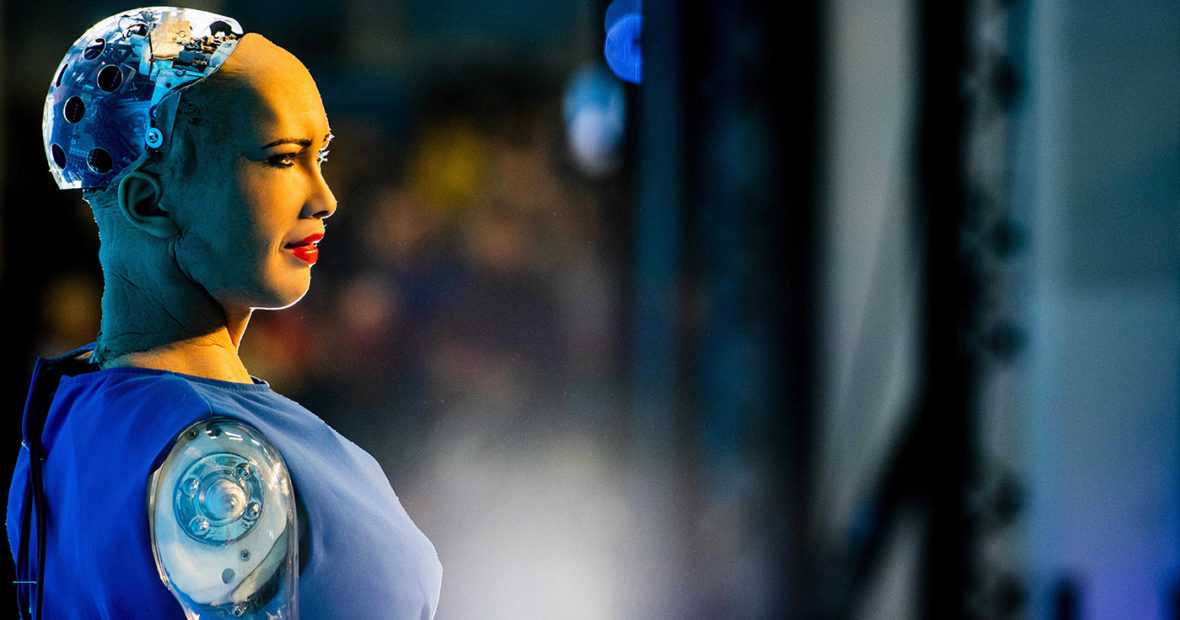
Due to the interference of AI in human world, the power of humanity as a species is about to increase dramatically because of a revolution in human-machine interaction which will see new forms of hybridity beyond our current imagination. Our human power will become even greater. But what about our wisdom and the way we use this new power of humanity? How will we behave with the non-human species on the earth? In short, what about the ethics of our behaviour in our new hybrid humanity?

Humanity as Ethical Behaviour

We now come to the second meaning of humanity which is used to describe a certain moral value i.e human behaviour that cares for other humans because of a profound and universally held conviction that life is better than death, and that to live well means being treated humanely and to treat others humanely so that everyone can live in peace and harmony.

This is not easy, of course, because the human species is ethically ambivalent and not simply driven by the ethic of humanity. Due to the reason we are deeply competitive, cruel and violent and often think of our own good only without thinking of others and often hurt them without feeling any remorse.
And what of humanity’s behaviour towards non-human life? In the era of climate crisis, environmental degradation and multiple species extinction, the question arises on moral principle of humanity itself. Quite simply, it is not even enough for humans to be kind to humans only.
The principle of humanity must, therefore, keep pace with the ethical evolution of humanity (the species) and needs to expand its purpose and behaviour towards human as well as non-human life i.e all animal and vegetative life. But, in future, it is also likely to include non-human machines like robots and AI which may develop their own levels of consciousness, feelings and rights as they can increasingly merge with humanity.
With all this uncertainty about what exactly it may mean to be human in future and the persistent record of our inhumanity to each other and towards non-human life, what sense does it make to try to aspire to a single global identity as billions of human beings?

Humanity as Global Identity

The third idea of humanity was taken into consideration when we felt that there was a need to build ourselves as a conflicted species 
and to build a single global political identity in which every human has a stake. This global identity is a meta identity which transcends smaller identities shaped by culture, nation, class, political opinion and religion.

The purpose of this single political humanity is to build a human “we” in which we all can share a common species consciousness as one group sharing a single “home” and then work together on common problems and common opportunities that face the whole of humanity.
This political sense of being a single global group is experiencing push-back today as a broad-based politics of ethnic and economic nationalism expresses scepticism about globalism of all kinds. This political turn sees many people asking national politicians to think “more about us here” and “less about them over there”. But it is important to build a global sense of humanity because our common human problems are intense and interdependent, and can only be solved internationally not just nationally.
There are five truly existential problems that we all share as members of the human species. Threats from each one can be significantly reduced if we work together to solve them in the spirit of Dumas’ Three Musketeers: “all for one and one for all”. 
1. The problem of our violence as a species as it plays out terribly in war and violent crime.
2. Our struggle for fairness and our desire to reduce inequalities between us.
3. Our predators and their threat to our health which now, have taken mainly microscopic forms such as infectious microbes, or chronic, autoimmune or psychological diseases in which we attack ourselves.
4. Our relationship with the non-human environment and its impact on human survival.
5. The promethean risk of our creativity and how our technological inventions help and harm as they change the world around us and redefine humanity itself in new hybrid forms.
These five deep species problems will require a powerful response by all humanity, with an ethic of humanity, to ensure the survival of humanity.
***